Origins
Destruction
Renaissance
The Norbertines & the Council of Trent
Not to forget ...
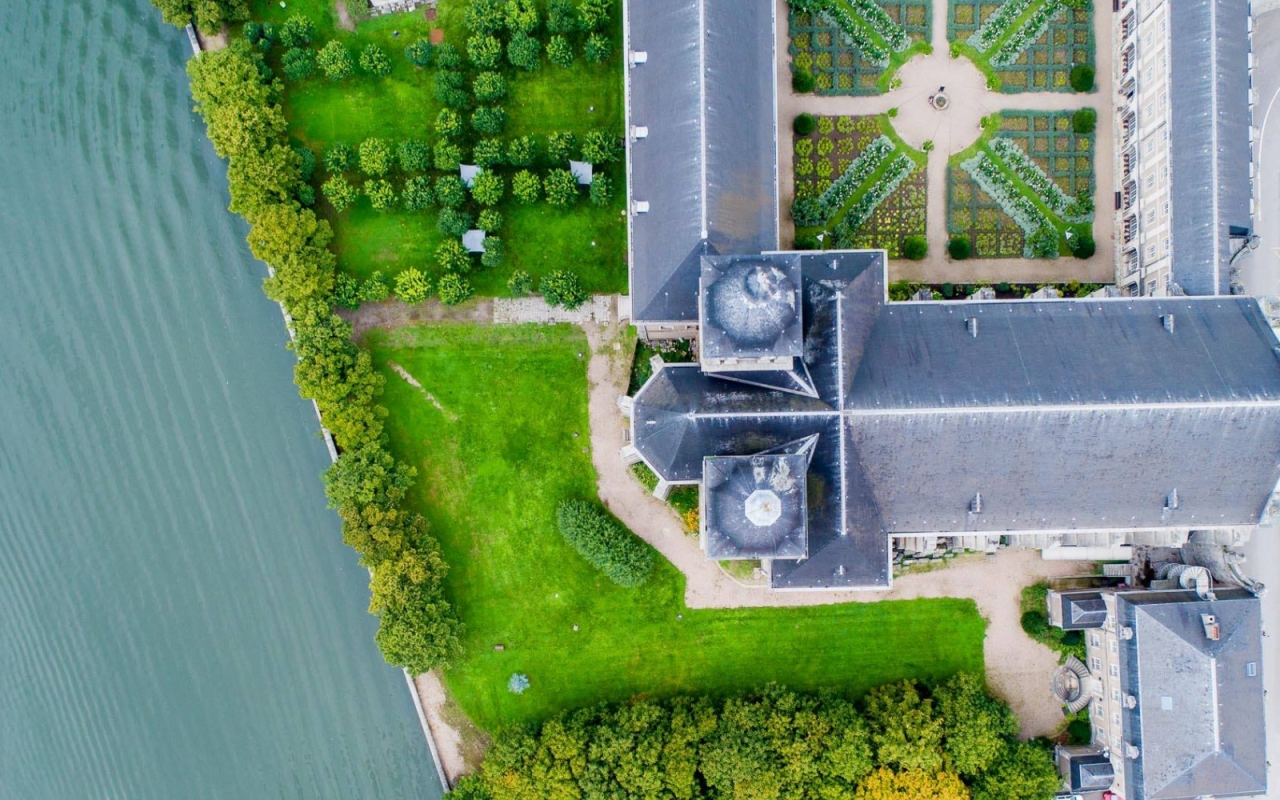
From the small abbey of Sainte-Marie-aux-Bois, located to roughly 10 kilometres from Pont-à-Mousson, the impressive Sainte-Marie-Majeure rose at the beginning of the 17th century, thanks to Servais de Lairuelz, the Norbertine abbot of Verdun and reformer of the order. He was helped by the Jesuits of the town who, with their university, turned the town into a religious and intellectual centre that very quickly became a bastion of the Catholic faith.
According to the present knowledge, the abbey was started in 1705 under the reign of duke Leopold I of Lorraine and the classical architect, Thomas Mordillac who laid the first stone.
Completed by Nicolas Pierson, it also leaves us an example of a stripping sober Baroque style.
Here, the religious and intellectual life was the most prosperous. On the death of duke Stanislas in 1766, the royal edict which had joined Lorraine to France abolished the Society of Jesus. It was a decline of most of the religious communities in the city.
Shortly after, the Revolution put an end to all the convents in the city. The Norbertine abbey was almost the only one to survive. In the 19th century, the bishopric of Nancy created a small seminary. The professors quit the building in 1906 due to the law separating the State from the Church.
The abbey became a Historical Building in 1910. It belonged to the State, then was given to the city in 1912. It became a civil hospice until 1944.
Since its construction and up to the end of the Second World War, the abbey suffered from damage of the time and the mankind’s madness.
Partly destroyed by a fire starting in the chimney of the warm room in 1771, it was restored over three years following the original plans of Nicolas Pierson.
It was not spared by the 1789 Revolution : emptied, divided up, put up for sale, it has remained abandoned for 25 years. It suffered under the revolutions of 1830 and 1848, which forced the monks to suspend their activities.
During the war in 1870, it was requisitioned by the War Secretary, which transformed it into a hospital. More than 26,000 wounded French and Germans were cared for there.
The law separating the Church and the State, passed on December 1905, meant that the battalions stationed at Pont-à-Mousson enter into the abbey. The damage was more serious than that caused by the Revolution.
The First World War obliged the government to declare Pont-à-Mousson an open city. Then the city found itself between the French and German firing.
The Second World War finished the destruction of the first.
At the beginning of September 1944, the abbey was pounded while the city was liberated. It was completely in ruins. Only the facades and the ground floor remained as well as the church. The stairs and the library had disappeared.
However, like the phoenix above the fireplace in the warm room and thanks to people’s efforts, it has risen from its ashes more beautiful than ever.
In 1945, the scale of work to be undertaken forced the municipal council to vote for the complete destruction of what still remained standing.
Fortunately, there were people who cared for their heritage and did not want to see this building disappear. It was a witness to the prestigious past of their city and Lorraine.
An association was quickly created. From the outset, it included the town of Pont-à-Mousson, manufacturers, notably the company Société des Hauts Fourneaux of Pont-à-Mousson, the department of Meurthe-et-Moselle, the Employers Federation and the Lorraine iron and steel industry association.
Planning licence was granted in 1959. And, thus the long task was embarked upon, involving architects, sculptors, fibrous plaster specialists, glaziers and wrought-iron craftsmen. It took no less than twenty years to re-build everything.
Like the Cistercian abbey of Royaumont, the Norbertine abbey was transformed into a Cultural Centre.
After huge works, the association was able to open part of the buildings to the public on October 1964.
In the 16th century, an important event marked the whole Church in its liturgy and spiritual thought : the Council of Trent.
This movement had also an influence on the architecture of the religions buildings as well as on the organisation of the monastic life in their monastery.
From 1545 to 1563, nearly all the bishops in the Christian world questioned the precepts of the Church.
Philosophers, humanists, mathematicians, astronomers … gave free range to their intellect in order to elaborate all sorts of new theories : the basis of modern sciences.
The Church witnessed these changes and became increasingly concerned.
In fact, the unshakeable Catholic Faith was weakening and falling off.
Protestantism undermined its foundations. It was necessary to bring people back to the faith, to catechise the persons who, from now on, only want to open up to the modern world. It is in this state of mind that the Church took a series of radical steps :
The churches were open to the faithful who could participate in the services
The rood-screen separating the chancel from the nave was destroyed
The light must penetrate into the temple and illuminate with a physical and spiritual light
The literate faithful followed the mass in the missal
The church becomes a public place again ; the place for everyone as described in the Bible!
Architects re-discovered the churches with very high halls and three naves of similar height.
At the end of the 16th century and especially in the 17th century, the Jesuits and the Norbertines were the propagators of the Council of Trent.
Whether it was for their reform or the construction of their buildings, the Norbertines were extensively inspired by the ideas of the Council : diocesan synod, pastoral visits, teaching young people … very large cloisters, a church hall.
If there are magical places in the abbey through the audacity
of their shaped and construction,
the stairs are among them..
Visit the Abbey ...