L'escalier rond
L'escalier ovale
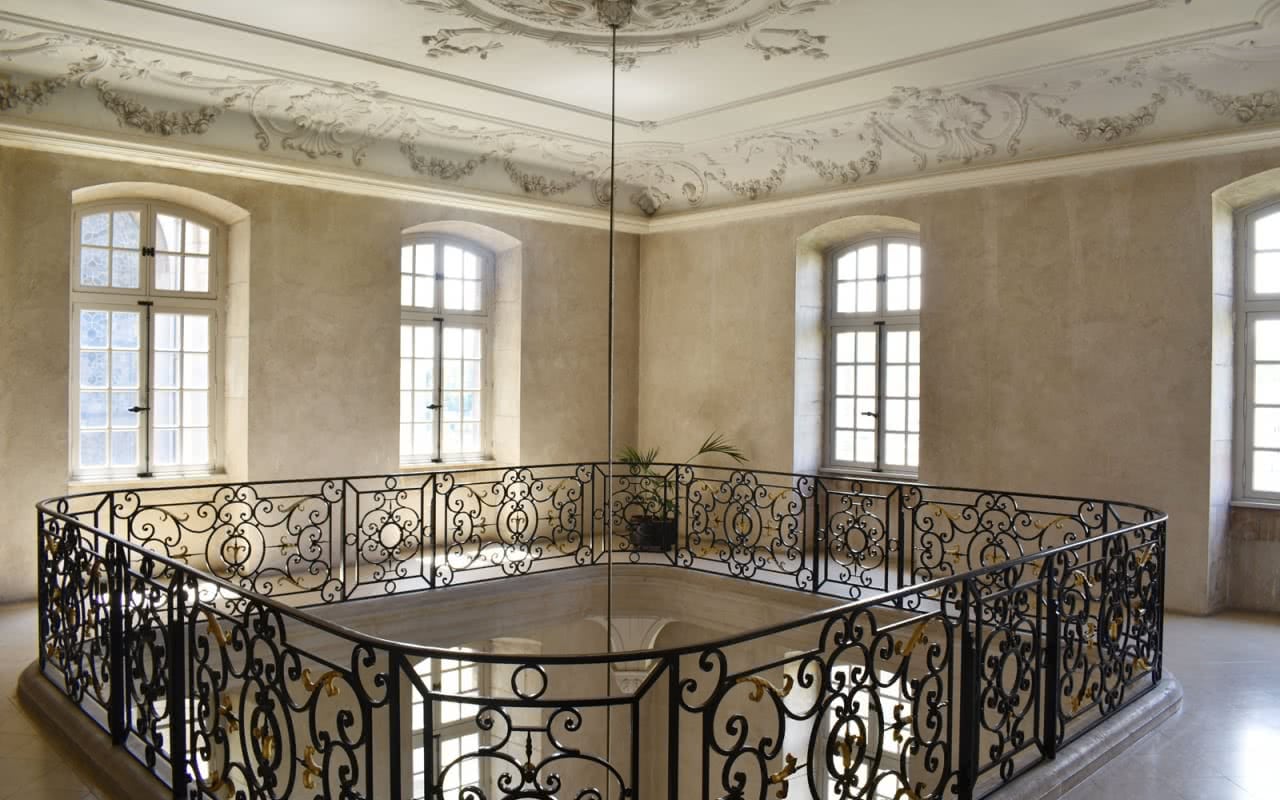
L'escalier carré
Le chauffoir
La salle capitulaire (Salle Saint Norbert)
Le réfectoire des Chanoines
Le cloître
La salle Thomas Mordillac
La salle des stations
La grande sacristie
L'Eglise abbatiale
The only staircase which was not destroyed in 1944. Its eighty steps rise to the second floor in lines so pure and so regularly refined that, when standing in its centre, the visitor will believe that he or she is in a bottomless well.
Even Pierrot with the feather to his ear, looking down on the curious visitor from his height, seems intoxicated by all its volutes and the simple wrought-ironwork in attempting to follow all its variations.
The second magical place in the abbey. Here we can see Atlas grimacing because of the surperhuman efforts of supporting the staircase’s weight.
Soaring arches with no apparent support. Only its stereotomy tells us the secrets of its construction : the stones are fitted together, one into the other, convexo-concave steps.
Finally, crowning everything a wrought-ironwork worthy of the Jean Lamour workshops in Nancy.
..
With the excellent restored work of its baroque curves, projected onto the paving, we can imagine the ceremonial staircase with its very low and wide steps.
The third magical place through its purity and elegance, is a classical construction : straight lines are omnipresent even in the wrought-ironwork of the rail.
Only the gallery of the second floor may reveal already the Baroque of Nicolas Pierson : stuccos and wrought-ironwork intertwined with its water-weed patterns.
Its situation, very close to the church, defined it stairs tor the matines, the night prayer around midnight.
The whole Baroque inspiration displays the architectural skills of Nicolas Pierson :
Basket-handle arch which is held up by visible double arches with sculpted springs of grotesque figures, fireplace finely decorated with its phoenix rising from its ashes.
The illusion is omnipresent. The alternation of stone lozenges, marble and grey mortar lets reveal cubes which fit together to infinity.
The central rose leaves the memory of the once richly worked ceiling stucco on the ground.
The profusion of details : Acanthus or Lorraine thistle leaves, Cross of Lorraine, ova, rosettes, shells, fleurs-de-lis patterns
No doubt that the monks liked to receive here their guests “people from outside”, princes, dukes, and perhaps even the royal family.
Located in the centre of the cloister, it allowed the processions to make their way to the church in a very liturgical fashion : the right for the priests rejoining the choir, the left for the novices and scholars rejoining the nave.
Unfortunately, today, the room (the most decorative in the abbey until 1944) has lost its splendour and wealth : no stucco or pilaster was spared.
It has been completely disfigured and without even a vague memory of the chapel that it was during the period of the Seminary and hospital …
We have nearly forgotten the Baroque arches hidden under the rough-cast plaster …
After the very beautiful door surmounted by a semi-circular fronton bedecked with the coat of arms of Nicolas Felix (abbot from 1717 to 1754) and Mgr Lavigerie (bishop of Nancy from 1863 to 1868), we discover one of the rare rooms in the abbey which has preserved its 18th century character.
Only the stuccos of the ceiling and the wall could not be restored.
The arches in the refectory have a distinctive point : basket-handle arches supported on ravens, a technique used by the architects to modify and reduce the thrust on the arch.
On the finely sculpted joists and consoles, we see Lorraine arms : cross, alerion, back to back bars, cross of Jerusalem … and the figures of Marie and Leopold duke of Lorraine.
The floor is still a baroque trompe-l’oeil : each medallion is a projection of that on the ceiling.
This space, still impregnated with spirituality, is the heart of the abbey. All the halls and stairs converge here.
However we are far from the monastic square with four galleries and their liturgical and canonical functions.
Here, three galleries (glazed since 1912) form a U closed by the church. The gallery of the Lectio Divina does exist no longer. This is one of the consequence of the Council of Trent.
The cloisters had to be reduced to mere corridors aligned with the upper floors, allowing much more light to enter.
Everything appears well balanced, yet one gallery extends to the edge of the gardens and goes quite a way beyond the buildings of the convent. This is the Sun gallery, built separately to shelter the dormitory of the novices and scholars above.
It is a very symbolic place since, in the evening, the setting sun is in line with and indicates the moment for vespers (approximately 6 p.m.)
The end of interlacing, curves and stucco …
This room more austere and surely more ancient is the result of the architect Thomas Mordillac.
Two bays with classical arches, with their fine ridges, are held up by one central column.
This room, and above all the following, announces already the abbey-church.
Its very sober style-doric decoration makes think that it is the abbey’s remains of the 17th century.
Some people see a dining room for guests, and why not a billiards room as found in lots of Norbertine abbeys of the 18th century ?
Each arch falls onto a fluted column.
The use of this room in the 18th century remains uncertain : did the monks prepare the mass as usual in a room with the stations, or was it used as a minor vestry for novices and scholars ?
It was used as a study room during the small seminary.
“Lavabo inter innocents manus meas”, “ I will wash my hands to purify them”.
This is the psalm pronounced by the priest in office before entering the church.
The large vestry, reserved for the priests, was the room where the office was prepared. The stone pattern – the washbasin- shows again the extent of the religious ceremonies to which the Norbertines went frequently.
Called also the Treasury, it held the ministerial garments, the religious relics and the blessed water. Then, in the 18th century, there was only this door which could give access by the square stairs.
Its architecture and dimensions are identical with the room of the stations.
They had a church built where a great deal of light could enter, thanks to windows only slightly stained, and quite open onto the central nave. Only grilles formerly closed off the choir.
The architect Thomas Mordillac was undoubtedly a visionary, an innovator in Lorraine architecture in the early 19th century. The church of Sainte-Marie-Majeure is considered by historians as a prototype. It is the first church hall in classical style in the region : three vessels of the same height covered with ridge arches and illuminated by very high glazed bays.
The church has extensively contributed to the history of art in the region and held school in many buildings.
The Baroque choir, left unchanged since the bombardment of 1944, was made by the architect Nicolas Pierson.
A religious ceremony on October, 1st 1976 put an end to its consecration.